


What kind of charcoal is best for an eel restaurant?
Explaining why Binchotan charcoal is recommended!
What kind of charcoal is best for an eel restaurant?
Explaining why Binchotan charcoal is recommended!
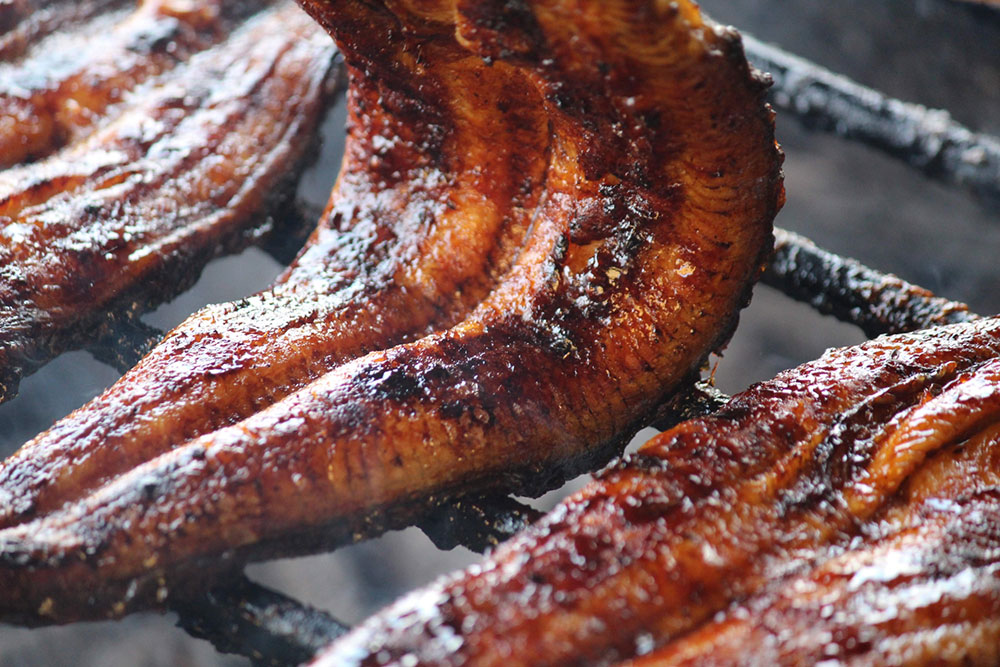
When it comes to foods that taste better when grilled over charcoal, many people probably think of eel.
The texture and concentrated flavor of eel grilled over charcoal is completely different from that of eel grilled over gas.
This article will provide a detailed explanation of the charcoal commonly used in eel restaurants, the important points to consider when choosing charcoal, and recommended charcoal.
Charcoal often used in eel restaurants
Eel restaurants often use two types of charcoal: binchotan and sawdust charcoal.
What kind of charcoal is each? We will give you a brief explanation!
What is Binchotan charcoal?
Binchotan charcoal is often used in restaurants other than eel restaurants, such as yakitori restaurants.
It is also known as "white charcoal."
The reason it is called white charcoal is because of the refining method used.
Binchotan is made by carbonizing charcoal in an earthen kiln, baking it at a high temperature of nearly 1200°C, and then extinguishing the fire with extinguishing powder (earth, ash, and water) all at once before refining it.
It is called "white charcoal" because the ash from the extinguishing powder that adheres to the surface of the charcoal during refining appears white.
Because it requires advanced skills to produce Binchotan, it is a premium charcoal among the many types of charcoal available. It is extremely hard, has a long burning time, and is an excellent charcoal with strong heat.
What is sawdust charcoal?
So what kind of charcoal is sawdust charcoal?
Oga charcoal is "eco-friendly charcoal made from recycled sawdust."
We have already introduced the manufacturing method for Binchotan charcoal, but sawdust charcoal is also made using the same method, and is quite similar in terms of performance.
For this reason, there are many cases where people have used binchotan charcoal but have found that sawdust charcoal would have been sufficient.
In such cases, you can reduce costs by switching to sawdust charcoal!
Characteristics of charcoal used in eel restaurants
What kind of charcoal is best for an eel restaurant? There are several essential elements to grilling delicious eel over charcoal.
We will introduce you to the characteristics of good charcoal.
Strong heat that doesn't let the flavor escape
Strong heat is essential to grill delicious eel.
The proteins contained in fish become hard when heated above 90°C, causing the juices to leak out and resulting in a less juicy finished product.
However, if you cook it at a low temperature for too long, the umami components will escape.
By grilling over powerful charcoal, it is possible to cook the proteins on the surface at a high temperature for a short time, thereby locking in the flavor.
We are able to serve eel that is crispy on the outside and fluffy on the inside, packed with flavor.
Emits a lot of far infrared rays
The far-infrared effect is also an essential element for making delicious baked goods.
Among all types of charcoal, Binchotan and Oga charcoal emit the most far infrared rays, said to be four times that of gas fires.
By using far-infrared rays, the eel can be cooked thoroughly without burning the outside or hardening the inside. This, combined with the smoky flavor, results in the ultimate eel dish.
Long burn time
Eel restaurants need to keep the fire going for long periods of time, from half a day to a full day, depending on their opening hours.
For this reason, charcoal with a long burning time is often used.
If charcoal with a short burn time is used, problems such as the operational burden of maintaining the fire and the inability to serve sudden orders due to insufficient heat can arise.
In other words, when choosing charcoal for an eel restaurant, it is important to pay attention to three points: heat output, far-infrared effect, and burning time.
For eel restaurants, we recommend "Binchotan" and "Oga charcoal"
The most commonly used charcoal is "binchotan" and "sawdust charcoal," and these are the two types we would recommend.
Our top recommendation is binchotan charcoal.
As mentioned earlier, when it comes to the important factors to consider when choosing charcoal for eel restaurants, such as heat output, far-infrared effect, and burning time, Binchotan charcoal is unmatched.
You can't go wrong with Binchotan charcoal, as it boasts top-level qualities in every aspect.
On the other hand, although sawdust charcoal is inferior to binchotan in terms of burning time, it is comparable to binchotan in terms of heat output and far-infrared effect. The burning times of binchotan and sawdust charcoal are as follows:
・Binchotan charcoal: about 8 hours
・Sawdust charcoal: 3 to 5 hours
Sawdust charcoal has the great advantage of being inexpensive, so it's a good idea to choose it based on your business hours and other circumstances.
For all your charcoal needs, visit Nakasho Shoten
We introduced the charcoal commonly used in eel restaurants, "Binchotan charcoal and Oga charcoal," and explained the important points to consider when choosing charcoal.
As explained above, Binchotan charcoal is a charcoal that has top-level performance in terms of heat output, burn time, and far-infrared effect. Also, sawdust charcoal is excellent in terms of cost, so it is a good idea to choose it depending on the situation.
Nakasho Shoten sells a wide range of high-quality charcoal, including binchotan and sawdust charcoal. Nakasho Shoten's charcoal is ideal for long-lasting flames, offers competitive pricing, and a stable supply. Be sure to try the charcoal produced by an eel wholesaler with over 90 years of history.